CHOWN (Change of Ownership) is an internal Telstra workflow that enables agents to transfer services between customers. As the workflow evolved, agents were required to manage increasingly complex service-selection tasks, billing account assignment rules and eligibility requirements across large datasets.
I worked closely with UX designer, stakeholders and developers to improve the Assign Billing Account experience. My contribution focused on reducing cognitive load, improving information hierarchy and surfacing critical decision-making information directly within the workflow.
I worked closely with UX designer, stakeholders and developers to improve the Assign Billing Account experience. My contribution focused on reducing cognitive load, improving information hierarchy and surfacing critical decision-making information directly within the workflow.
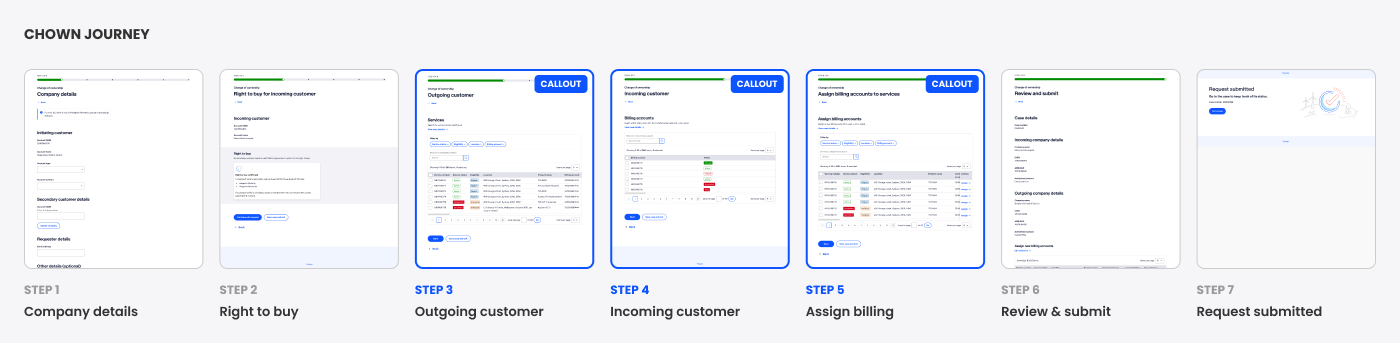
Problem
Through workflow reviews, requirement discussions and implementation workshops, three recurring themes emerged.
1. Information overload reduced focus
Customer and case information were introduced earlier in the journey, but continued to be displayed throughout later steps. As additional requirements were added, pages became increasingly long and difficult to navigate, requiring agents to scroll between reference information and task-related actions.
2. Eligibility wasn't obvious
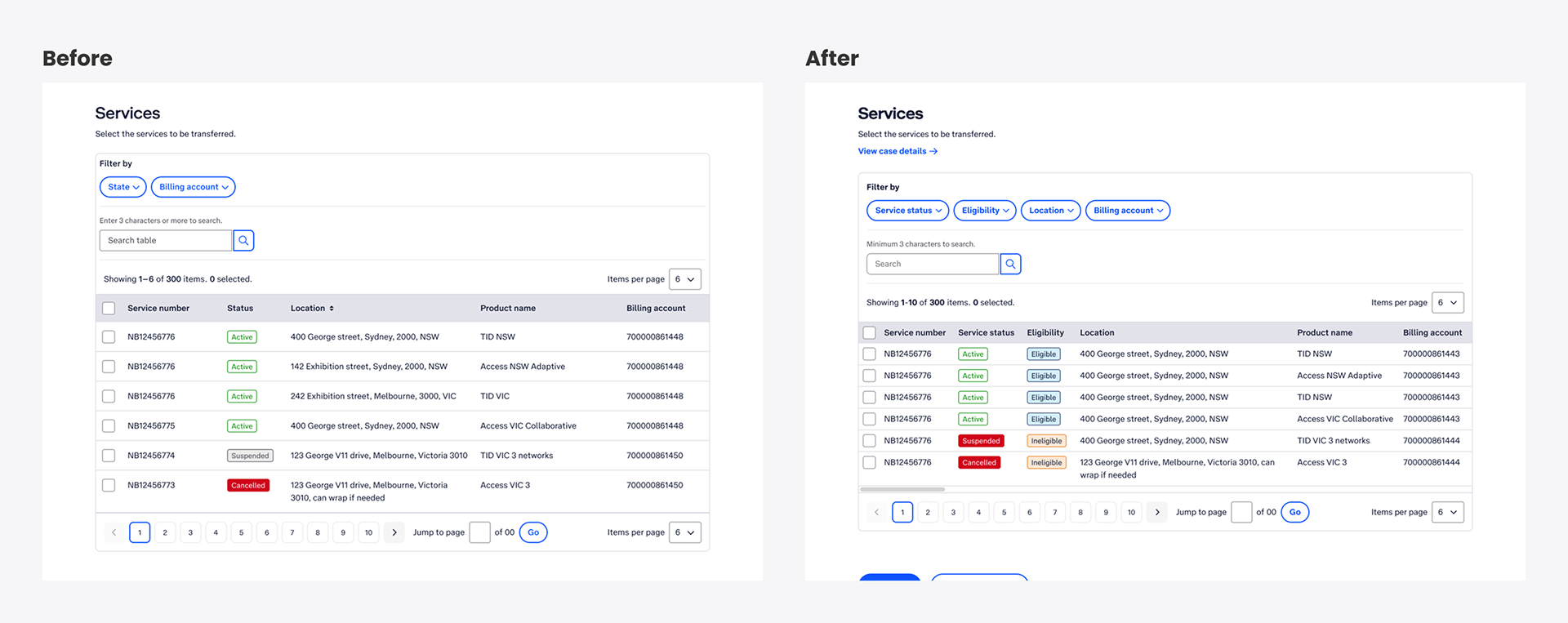
Agents needed to determine which services could proceed through CHOWN, but service status and billing-account eligibility were often confused. Backend statuses represented operational system states rather than assignment readiness, making them difficult to interpret.
3. Step 5 required additional guidance
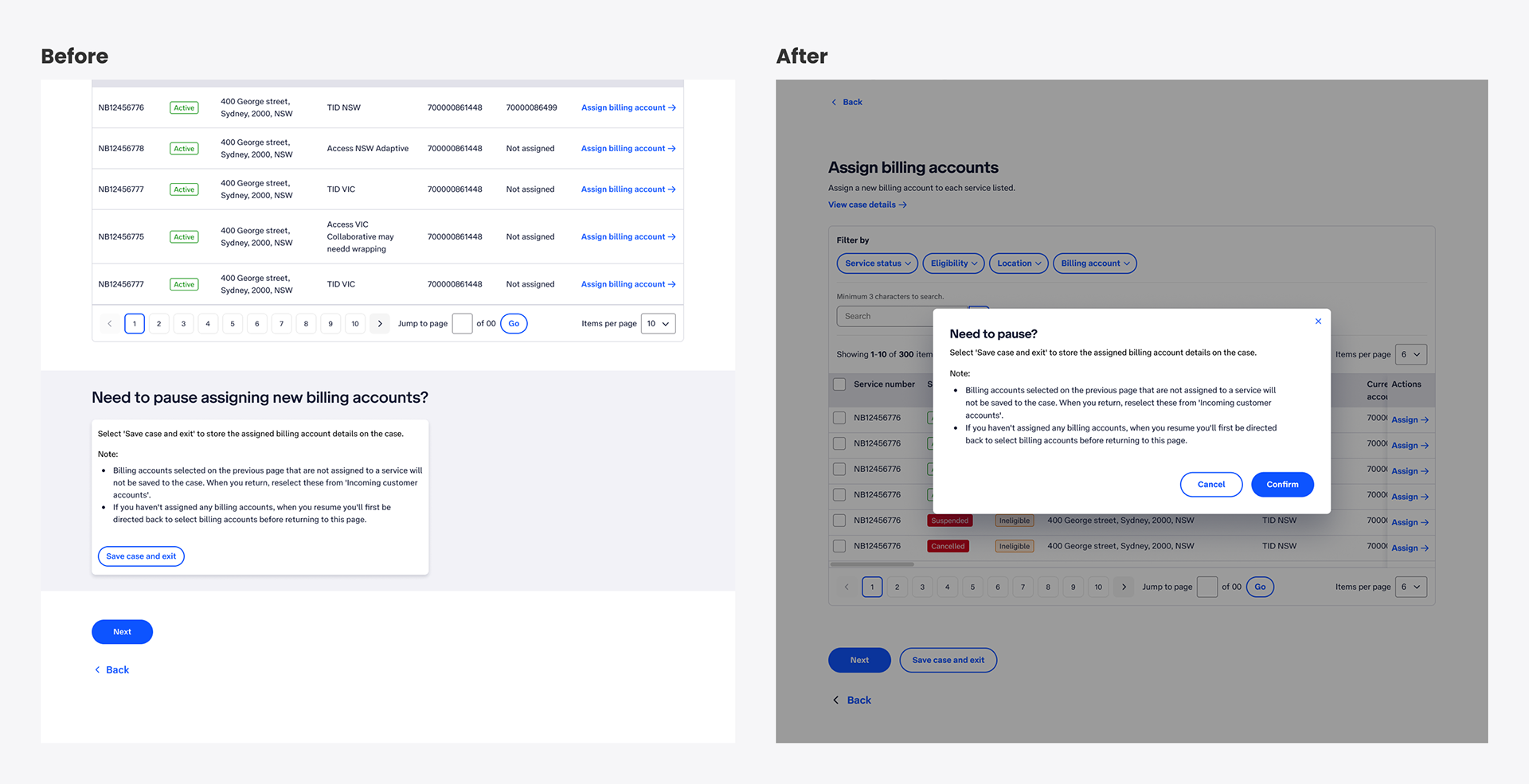
Billing accounts were only assigned in Step 5. Users needed guidance around saving and exiting because billing-account availability and eligibility could change over time, potentially affecting how the request resumed.
Design Decision 1
Reducing information overload with contextual side sheets
Challenge
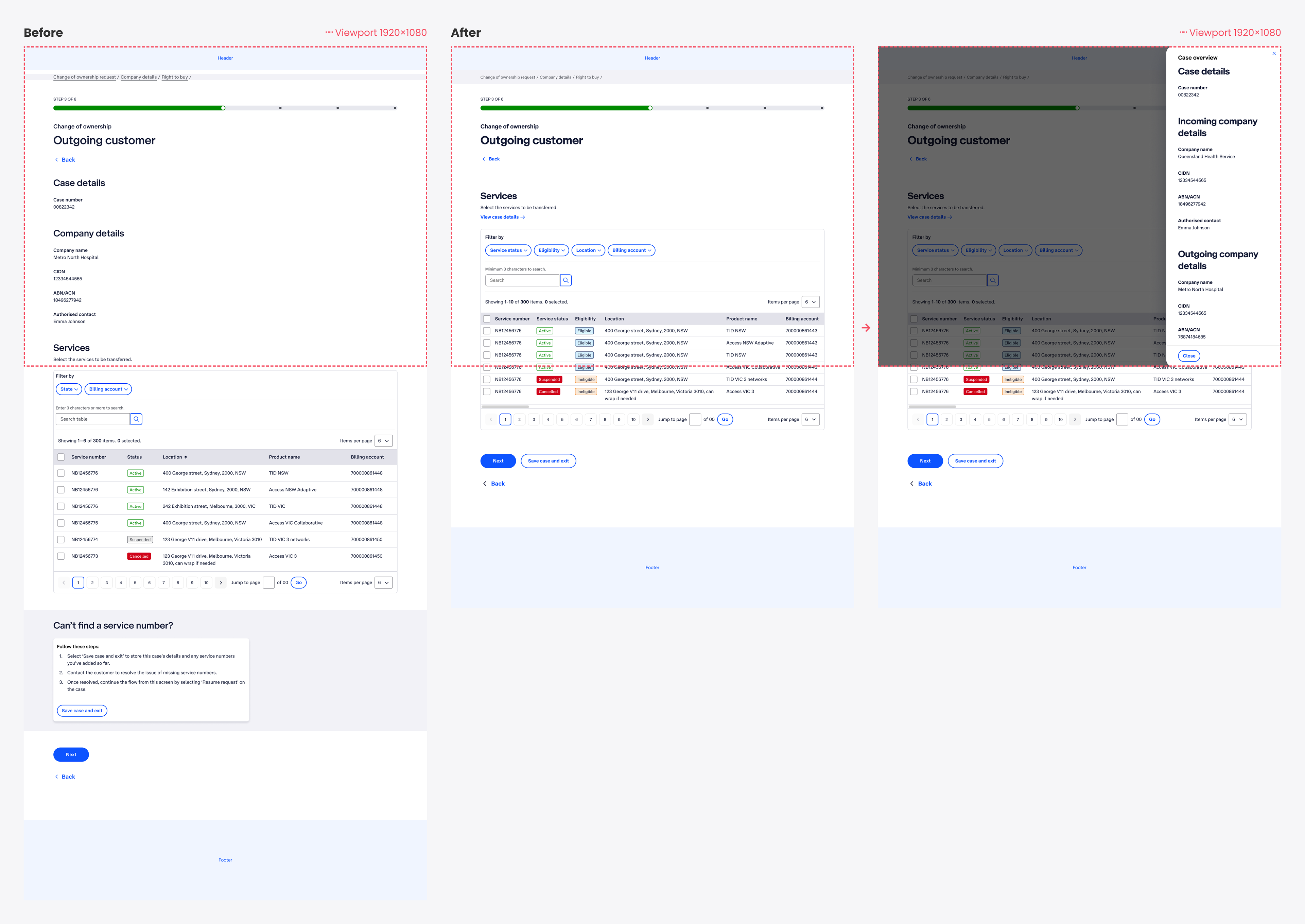
Customer and case information were already introduced earlier in the CHOWN journey but continued to be displayed throughout Steps 3–5.
As more content was added, pages became increasingly long and difficult to navigate. Agents were required to scroll between reference information and task-related actions, making it harder to focus on the primary task at each stage.
The challenge was to reduce page length and repeated information while ensuring important context remained accessible.
As more content was added, pages became increasingly long and difficult to navigate. Agents were required to scroll between reference information and task-related actions, making it harder to focus on the primary task at each stage.
The challenge was to reduce page length and repeated information while ensuring important context remained accessible.
Exploration
I explored several approaches:
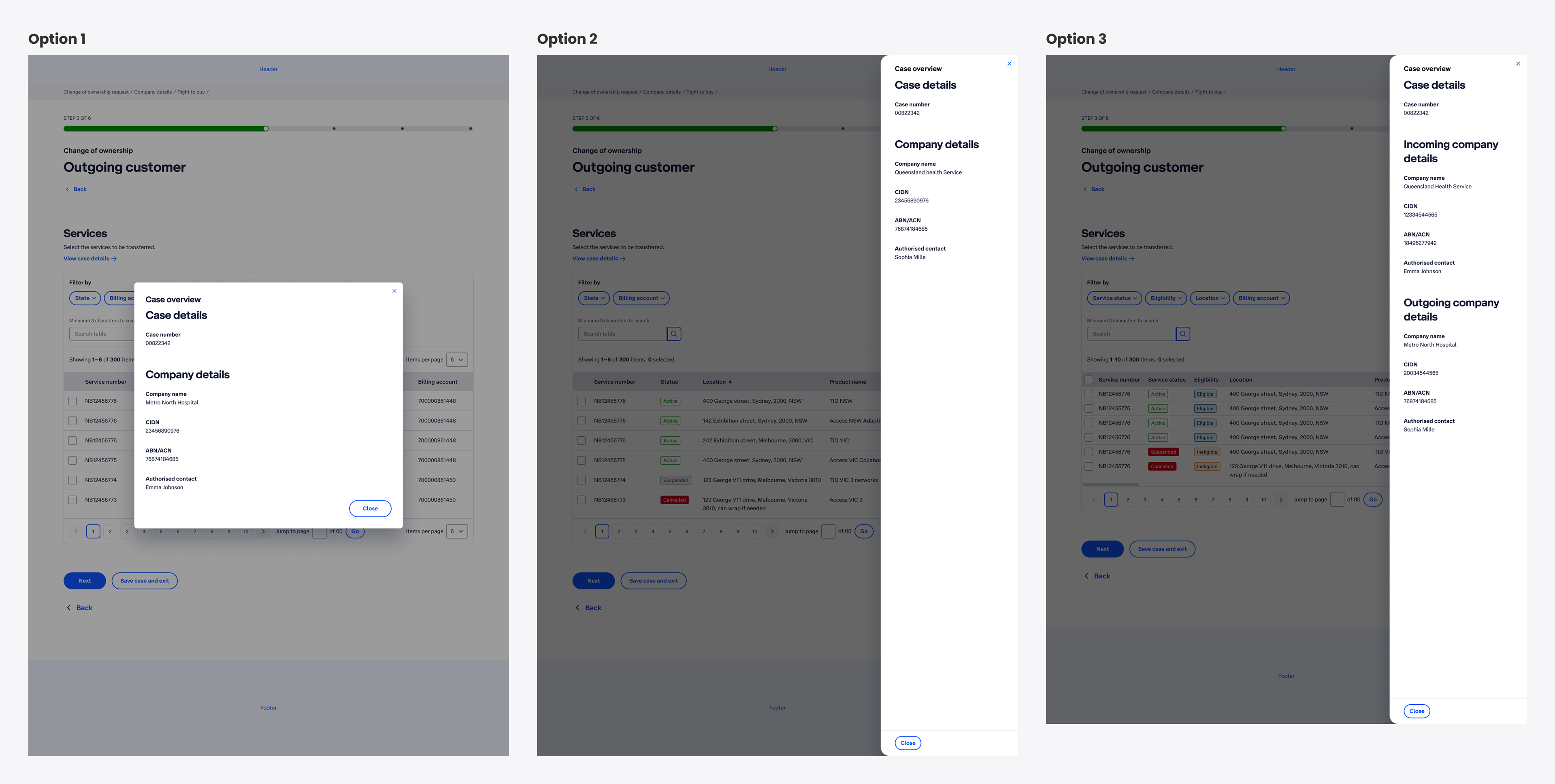
Option 1 - Display Case Details and Company Details in a modal when users required additional context.
Option 2 - Display Case Details and Company Details in a contextual side sheet.
Option 3 - Through exploration, we found that simply showing a single company record wasn't enough.
CHOWN can be initiated by either the Incoming or Outgoing company, meaning agents needed visibility of both parties throughout the ownership transfer process. While this information was introduced earlier in Step 1, the side sheet was expanded to include both parties’ details, keeping context accessible when completing tasks in Step 3-5 while reducing page density.
Option 1 - Display Case Details and Company Details in a modal when users required additional context.
Option 2 - Display Case Details and Company Details in a contextual side sheet.
Option 3 - Through exploration, we found that simply showing a single company record wasn't enough.
CHOWN can be initiated by either the Incoming or Outgoing company, meaning agents needed visibility of both parties throughout the ownership transfer process. While this information was introduced earlier in Step 1, the side sheet was expanded to include both parties’ details, keeping context accessible when completing tasks in Step 3-5 while reducing page density.
Trade-offs
Keeping customer and case details permanently visible improved discoverability but contributed to longer pages, excessive scrolling and reduced task focus.
Moving this information into side sheets introduced an additional interaction, but shortened pages, reduced repetition and helped agents focus on completing workflow tasks.
Moving this information into side sheets introduced an additional interaction, but shortened pages, reduced repetition and helped agents focus on completing workflow tasks.
Final Solution
A consistent side-sheet pattern was introduced across Steps 3–5, moving customer details, case information and supporting content out of the primary workflow while keeping them accessible on demand.
Outcome
• Reduced page length and scrolling
• Improved navigation
• Reduced repeated information
• Increased focus on task completion
Design Decision 2
Separating eligibility from backend status
Challenge
Business and product stakeholders identified ongoing confusion between service status and billing-account eligibility.
Agents needed to understand whether a service could proceed through billing-account assignment, but backend systems exposed operational statuses such as:
Agents needed to understand whether a service could proceed through billing-account assignment, but backend systems exposed operational statuses such as:
• Created
• Active
• Inactive
• Suspended
• Final
These statuses did not clearly communicate assignment readiness.
Exploration
Iteration
Through discussions with product and developers we refined:
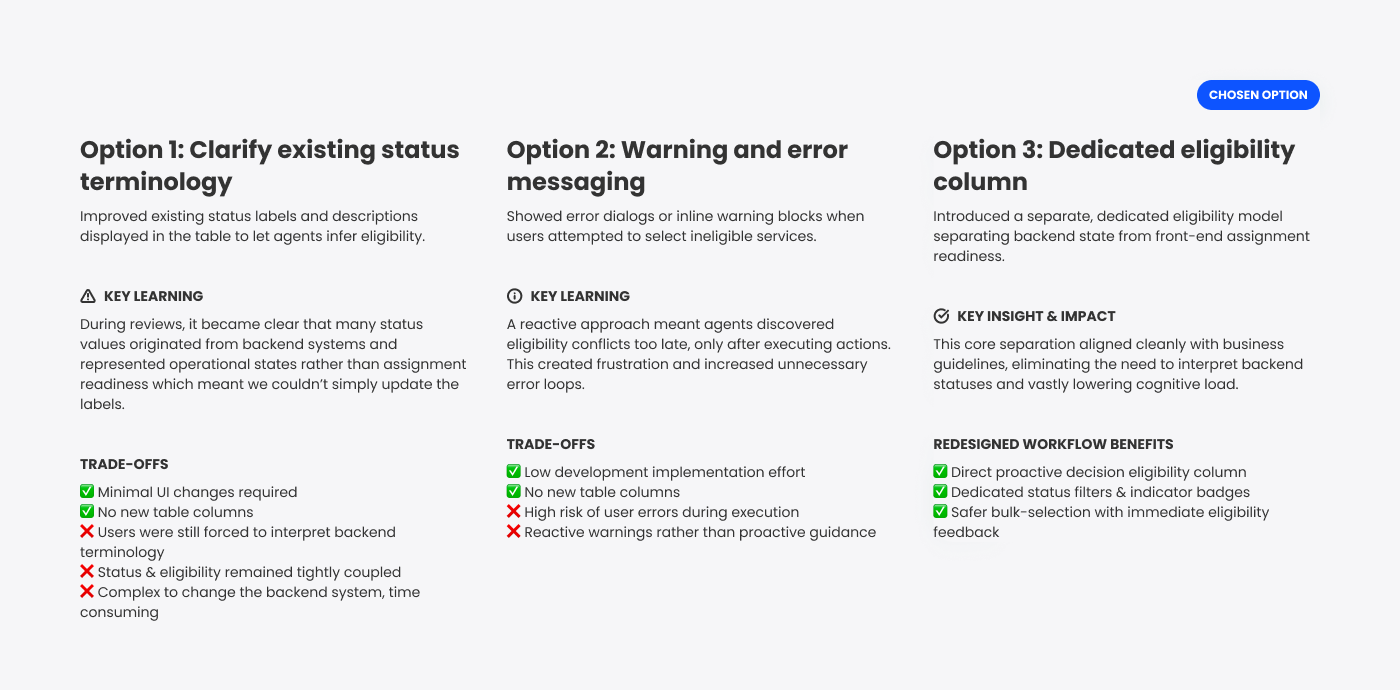
As requirements became clearer, the solution evolved away from changing status labels and towards introducing a dedicated eligibility model.
• What eligibility should represent
• How it differed from status
• How ineligible services should be represented
• How filtering could support the workflow
As requirements became clearer, the solution evolved away from changing status labels and towards introducing a dedicated eligibility model.
Final Solution
The redesigned experience introduced:
• Eligibility column
• Eligibility indicators
• Eligibility filtering
• Service status visibility
• Improved selection interactions
Outcome
The workflow shifted from:
"What does this status mean?" to "Can this service be assigned a billing account?"
The result was a clearer decision-making experience that reduced ambiguity and reliance on process knowledge.
"What does this status mean?" to "Can this service be assigned a billing account?"
The result was a clearer decision-making experience that reduced ambiguity and reliance on process knowledge.
Design Decision 3
Improving guidance at the billing account assignment step
Challenge
Step 5 was the only stage where billing accounts were assigned.
Users needed to understand the implications of saving and exiting because billing-account availability and eligibility could change over time. If users resumed the workflow later, they could be redirected to an earlier step before continuing.
At the same time, permanently displaying this information increased page density and competed with the primary task.
Users needed to understand the implications of saving and exiting because billing-account availability and eligibility could change over time. If users resumed the workflow later, they could be redirected to an earlier step before continuing.
At the same time, permanently displaying this information increased page density and competed with the primary task.
Exploration
I reviewed how supporting information was presented and explored whether guidance should remain permanently visible or be introduced contextually when required.
Final Solution
The "Need to Pause?" modal was placed exclusively in Step 5 and displayed when users selected Save and Exit.
Rather than occupying space throughout the page, guidance was surfaced at the moment users needed it most.
Rather than occupying space throughout the page, guidance was surfaced at the moment users needed it most.
Outcome
• Reduced page clutter
• Improved focus on billing-account assignment
• Increased awareness of save-and-exit behaviour
• Balanced guidance and workflow efficiency
Reflection
The biggest insight from CHOWN was that the problem wasn't a lack of information, but how information was prioritised and presented. By reducing repeated content, separating eligibility from backend terminology and surfacing guidance contextually, the workflow became easier to navigate and supported faster, more confident decision-making.